

The Power of Motifs in Music


Have you ever wondered, while enjoying epic classic films, about that recognisable tune when Superman takes flight to the rescue, Indiana Jones embarks on an adventure, or Luke Skywalker arrives to save the princess?


Do you remember those moments when we played video games and the iconic themes stuck in our heads all day? These musical motifs often become inseparable from the experience — instantly recognisable and emotionally resonant. From The Legend of Zelda to Super Mario Bros, such themes help shape the identity of the game and stay with us long after we’ve stopped playing.
Now, we’re here to introduce the true hero of our topic — musical motifs.
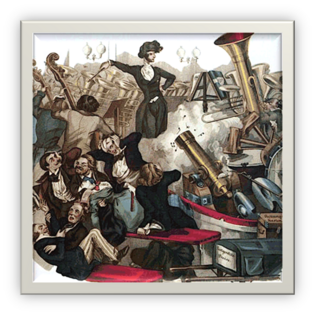

Hector Berlioz Caricature (1850), Anton Elfringe© Wikimedia Commons
During the 19th century, the use of motifs was largely developed by the New German School (Neudeutsche Schule), led by radical composers such as Hector Berlioz, Franz Liszt, and Richard Wagner. Berlioz, an early pioneer, employed the Idée fixe (fixed idea) concept in his Symphonie Fantastique. He used a recurring theme to symbolise the artist and his love interest and famously quoted the Gregorian chant Dies Irae in the symphony’s finale. This implied the artist’s tragic fate — executed by guillotine and witnessing his own funeral.
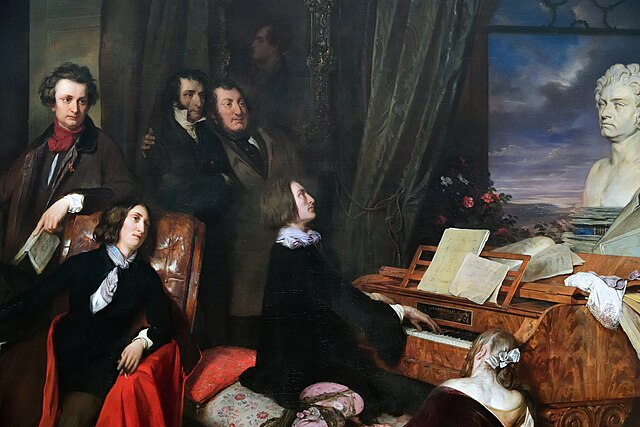

Liszt at the piano (1840), Joseph Danhauser © Wikimedia Commons
Liszt experimented with musical cryptograms, most notably using the B.A.C.H motif (where “B” represents B flat and "H" represents B natural in German notation) as the central theme of his organ fantasy, paying homage to Johann Sebastian Bach, a master of organ composition. Wagner, on the other hand, developed the leitmotif (leading motif) extensively in his operatic works. In Wagner’s compositions, leitmotifs became the defining musical identity of each character, allowing audiences to instantly recognise their presence whenever their theme emerged.
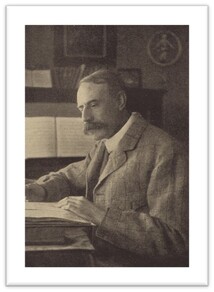

Edward Elgar (1918), J. Cuthbert Hadden © Wikimedia Commons
One of Edward Elgar’s greatest works, the Enigma Variations, incorporated name motifs based on the initials of his close friends. The first variation represents his wife, Caroline Alice Elgar (C.A.E.), while the final variation symbolises Elgar himself (E.D.U.). The work is full of encoded themes and mysteries, encouraging audiences to decipher the identities behind each variation.
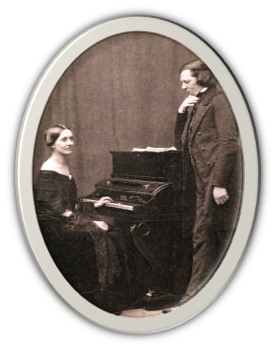
Clara (left) and Robert Schumann (right) (1850), Johann Anton Völlner © Wikimedia Commons
Where did Elgar find inspiration for constructing motifs in his composition? The answer likely lies in the Romantic composer Robert Schumann, whom Elgar regarded as “my ideal”. Schumann had a fondness for name-based motifs, as seen in his Abegg Variations (based on the name of his fictitious friend Abegg) and his final composition, the Ghost Variations (inspired by themes he believed were dictated to him by the spirit of his late friend, Felix Mendelssohn). He frequently embedded secret motifs in his works to represent friends and loved ones, including his wife Clara Schumann, whose theme appears in multiple compositions, such as Piano Sonata no. 1 and Carnaval.

Motifs can be a fantastic way for composers to express themselves, as they help create a musical character that everyone can recognise. You might even consider creating one of your own!


The famous “Fate” motif from Beethoven’s 5th Symphony © Wikimedia Commons
- Musical Motifs: A musical motif is a short, repeated musical idea — like a few notes or a rhythm — that gives a piece its identity
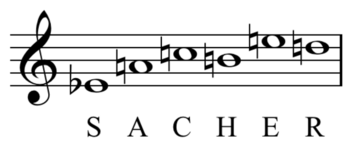
An example of Musical Cryptogram from Boule’s Messagesquisse © Wikimedia Commons
- Musical Cryptogram: A musical puzzle or message written in code, where the original text is encrypted using a cipher or letter substitution. The challenge is to decode it and reveal the hidden message.
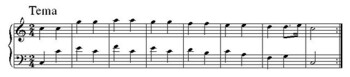
An example of a theme of a Musical Variation from Mozart’s variations on Ah vous dirai je Maman © Wikimedia Commons
- Musical Variations: A variation in music is a technique where a theme (a melody or musical idea) is repeated but changed slightly each time. Changes can include rhythm, harmony, tempo, or instrumentation, while the original theme remains recognisable.

- Do you recall a favourite music motif from a famous movie or TV shows?
- Can you think of a short tune or melody from a song, movie, or game that you always recognise? Why do you think it sticks in your mind?
- If you were creating a music variation, which theme or motif would you choose as your starting point?
By Kent Lam (2025)